WardWatch
Privacy-preserving BLE indoor patient tracking system for hospital environments, combining localisation, mesh coordination, and live dashboard delivery without visual surveillance.
Project Overview
WardWatch is a hospital indoor positioning system designed to track vulnerable patients, especially dementia patients, without relying on cameras or visual surveillance. The system combines BLE wearable tags, fixed anchors, Kalman-filtered RSSI ranging, weighted least squares trilateration, ESP-NOW mesh coordination, and a Pico W gateway that republishes location data over MQTT to a live dashboard. The core design goal was to balance privacy, low deployment cost, and practical system-level reliability in a hospital environment.
Key Highlights
Built a privacy-preserving indoor patient tracking system using BLE wearable tags, fixed anchors, ESP32 zone nodes, and a Raspberry Pi Pico W gateway.
Applied Kalman-filtered RSSI ranging and Weighted Least Squares trilateration to achieve room-scale patient localisation.
Designed an ESP-NOW mesh layer with leader election, relay routing, and failure recovery for resilient multi-node communication.
Implemented a Pico W UDP-to-MQTT gateway that validates packets, suppresses duplicates, and forwards location and health telemetry to a live dashboard.
Separated patient location and infrastructure health into dedicated MQTT topics for clearer observability and integration.
Demonstrated a camera-free tracking approach for hospital environments where privacy, cost, and deployment practicality matter.
Problem
Hospitals face difficulty tracking vulnerable patients across rooms and corridors without compromising privacy. CCTV introduces blind spots, requires active monitoring, and raises ethical concerns in patient rooms, while manual observation is labour-intensive and difficult to sustain. Existing BLE prototypes also tend to focus on single-sensor performance rather than distributed communication, failover, and real deployment reliability.
Solution
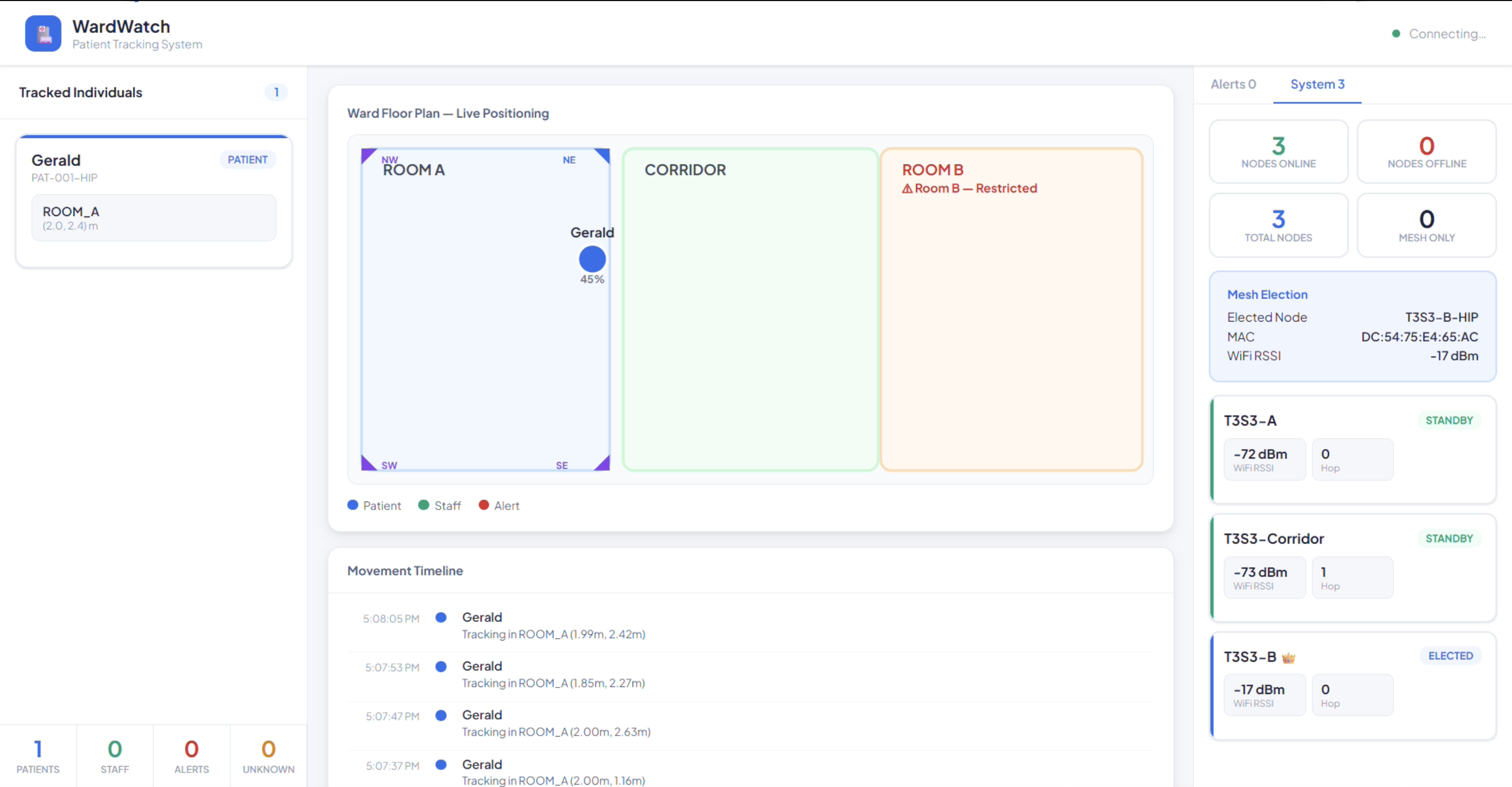
WardWatch uses a distributed BLE-only architecture. A wearable BLE tag is scanned by fixed anchors, which smooth RSSI using a Kalman filter before forwarding ranging data to a zone node. In the primary room, the system applies Weighted Least Squares trilateration to estimate patient coordinates, while ESP-NOW provides inter-node mesh coordination, relay routing, and leader election. The elected node forwards events via WiFi UDP to a Pico W gateway, which validates payloads, suppresses duplicates, and republishes both location and node-health data over MQTT to a live dashboard. The poster’s data pipeline and room layout illustrate this full flow from BLE sensing to dashboard delivery.
Outcome
The prototype achieved approximately 0.45 m mean positional error in the primary room and around 94.8% zone detection accuracy, showing that room-scale patient tracking is feasible with a low-cost, camera-free architecture. End-to-end latency was higher than the original real-time target, but the main bottleneck was traced to the dashboard polling layer rather than the BLE ranging, trilateration, or mesh communication pipeline. Overall, the system demonstrates a strong trade-off between privacy, cost, and practical IoT deployment for hospital settings.