IoT Healthcare Monitoring System
IoT-based home healthcare system built to improve elderly care through remote monitoring, automated medication management, and real-time caregiver alerts.
Project Overview
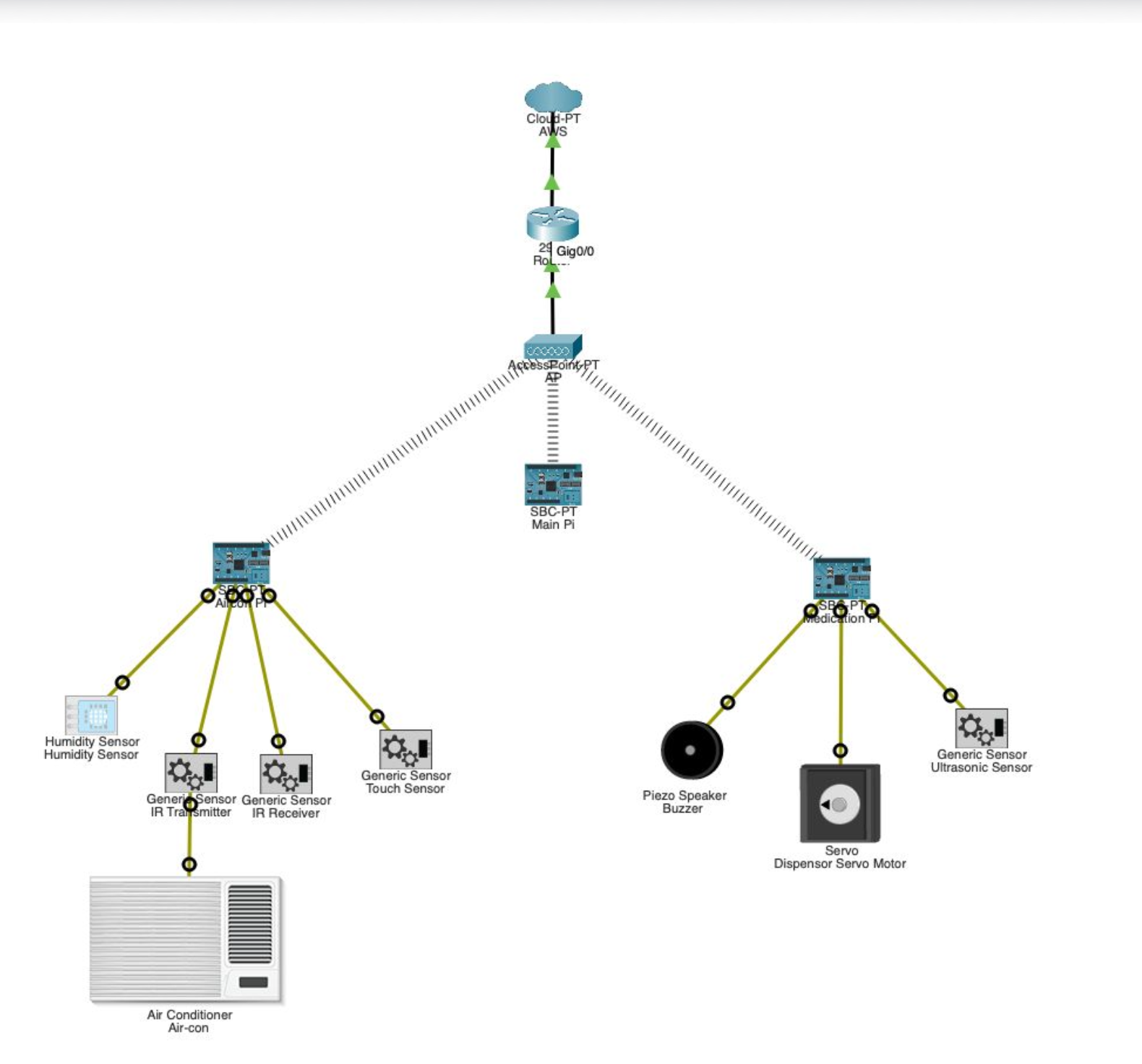
This project is an IoT-based healthcare monitoring system designed to improve elderly care at home. By connecting sensors, smart devices, and Raspberry Pi nodes, the system tracks living conditions, supports emergency response, and automates medication-related workflows. Caregivers are able to monitor and interact with the system remotely through a web interface, reducing burden while improving safety and comfort.
Key Highlights
Built an end-to-end IoT healthcare monitoring system using Raspberry Pi to support elderly care at home.
Integrated temperature, humidity, touch, and ultrasonic sensors for real-time monitoring and user verification.
Implemented automated medication dispensing with servo control and missed-dose notification flows.
Designed real-time communication pipeline using MQTT, AWS SNS, and AWS SQS for device control and caregiver alerts.
Developed a Flask-based control interface for caregivers to remotely monitor devices and trigger actions.
Added SMS-based emergency alerts and access control concepts through blockchain smart contract verification.
Problem
Elderly individuals living alone often need continuous support for medication, environmental comfort, and emergency response, but caregivers cannot always be physically present. This creates challenges around missed medication, delayed help during distress, and limited visibility into daily conditions at home.
Solution
We designed a distributed IoT system that combines sensors, embedded devices, and cloud messaging. Environmental and interaction data are collected through sensors, while medication is dispensed automatically with confirmation checks. A Flask web server gives caregivers a remote control interface, and commands flow through AWS SNS and SQS before being executed via MQTT across device nodes. SMS alerts notify caregivers of emergencies and missed doses, while blockchain-based verification was explored for secure access control.
Outcome
The project resulted in a working prototype that demonstrates real-time monitoring, alerting, and automated medication support for elderly care. It strengthened my experience with embedded systems, networking protocols, cloud messaging, and end-to-end system design, while showing how hardware and software can be combined to solve practical healthcare problems.